Your marketing budget is working hard. It's just working for the wrong things.
.webp)
Cultural Strategy
Australian brands are spending more on marketing than ever before and getting less back. The data explains why. The brands that are winnning are not spending more. They are doing things differently.
There is a question every founder and CMO eventually confronts. Usually after a launch that looked strong on paper and felt hollow in reality. The campaign ran. The spend was justified. The reach numbers came back respectable. And yet three months later…nobody is talking about it. Nobody remembers it. It left no trace.
The instinct is to assume the execution was off. Brief the next campaign harder. Spend more on the next activation. But the evidence suggests the problem is not the execution. It is the model itself.
Australian audiences do not behave the way traditional marketing models assume they do. And the brands winning right now have built their entire strategy around that difference.
The numbers most marketing decks do not include
Australia is one of the highest trust-transfer markets in the world. Which means the single most powerful force in any brand's growth is not reach, but reputation. Not impressions, but the conversations happening in rooms, group chats, and dinner tables that no media buy can manufacture.
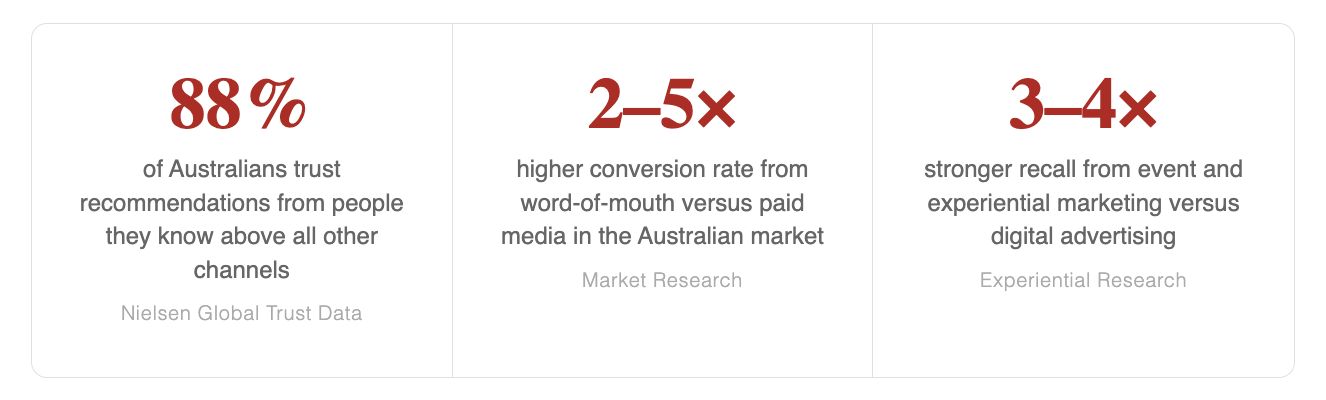
These are not small margins. A channel that converts at five times the rate of your paid spend and costs nothing to run once the set-up is non-negotiable. It is the most important asset in the building.
And yet most Australian marketing budgets are still structured around the channels with the weakest trust signal: paid social, programmatic display, and influencer campaigns that audiences have learned to read as advertising within seconds of encountering them. Influencer engagement rates in Australia run 20–30% lower than US averages. The audience here is smaller, more sceptical, and considerably harder to fool.
The US playbook consists of high-frequency paid media, large creator ecosystems, conversion driven by reach and repetition, and does not translate directly to this market. Australia rewards a different approach entirely.
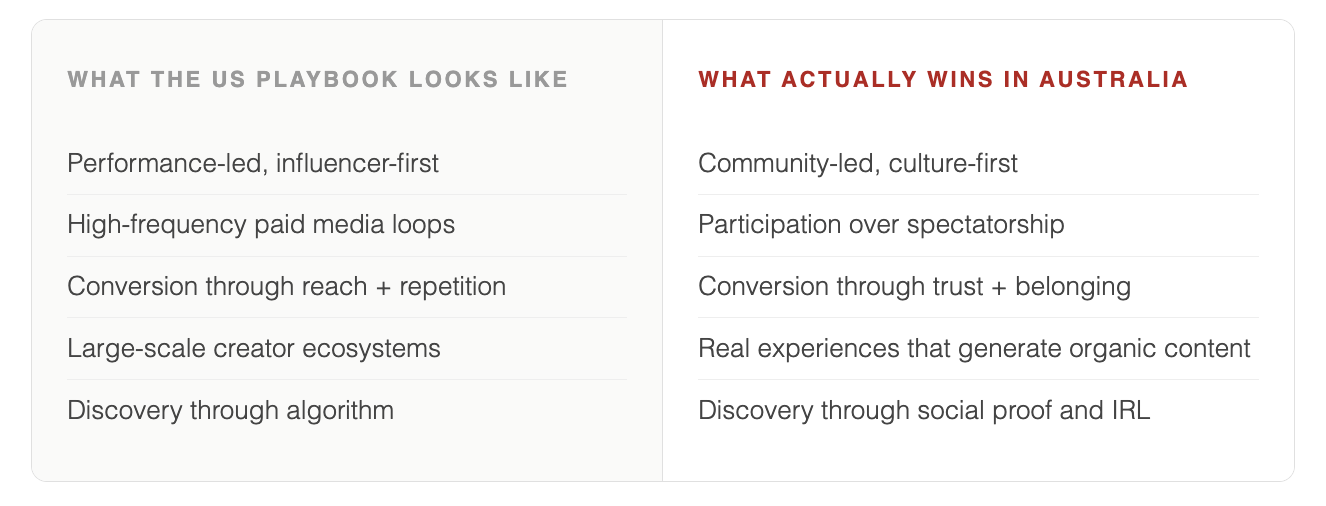
New Balance understood this. Their recent Metro of Madness activation which was not built on paid media. It was built on community-first run culture, participation over spectatorship, and moments that generated massive organic content because the experience itself was worth sharing. Unofficial Run Club has no paid media engine. It is built entirely on belonging and ritual that drives repeat engagement that most paid campaigns cannot touch.
To win in Australia, a brand cannot just be seen. It has to be experienced, shared, and belonged to.
The launch model is producing diminishing returns. Here is why.
The standard product launch model was built for a different media environment. A compelling story, a well-pitched journalist, a moment worthy of editorial coverage and a brand could earn reach that money could not replicate. That channel has contracted sharply. Independent editorial in Australia has shrunk significantly, and traditional PR now delivers a fraction of what it once did for most brands.
What replaced it was paid media. And audiences have developed a near-perfect ability to filter it out. The result is a model where budgets grow, reach expands and being remembered, talked about and trusted stays stubbornly out of reach.
The brands that have broken this pattern are not spending more. They have changed the fundamental premise of what they are building. The launch, for them, is not the destination. It is the ignition point.
"Your launch is not the moment. The moment is just the beginning."
Most brands design the moment and fail to design what the moment is supposed to produce. A moment without a content strategy is a tree falling in an empty forest. A content strategy without community activation performs once and disappears. Community without momentum is energy that dissipates before it compounds. The full sequence has to be designed rather than assumed.
The framework behind the brands running a different race
The Cultural Moment Engine is the architecture for designing that full sequence. Built across two decades of producing extraordinary brand experiences globally including the world's largest Ferrari Cavalcade, immersive programs for Bell Flight, and activations across four continents. It is a way of thinking that applies to any brand, at any scale, in any market.
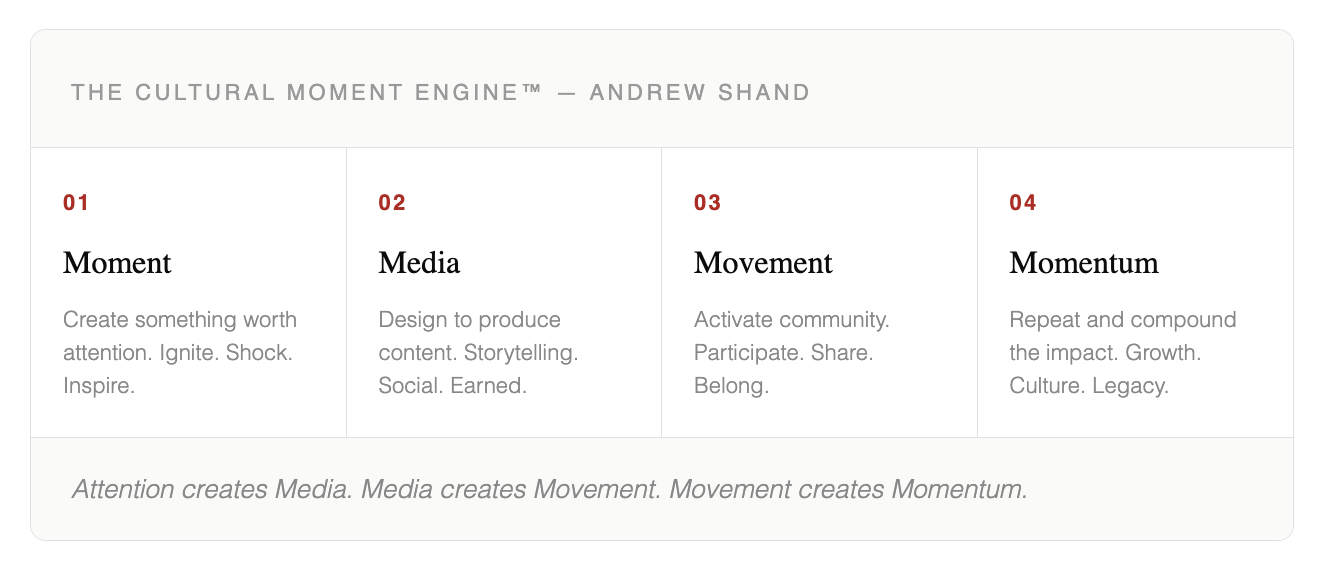
Each stage must be deliberately designed. The Moment creates the raw material. The Media strategy determines how far it travels. The Movement transforms an audience into a community. And Momentum is what happens when the system compounds over time, each cycle building on the last.
The brands running this engine do not talk about campaigns. They talk about assets as experiences and content that appreciate in value over time rather than depreciate the moment the media budget stops.
What happens when every stage is designed. Not just the first one.
When Ferrari marked its 75th anniversary with its first-ever and largest Tour outside of Europe, the brief could have been straightforward: deliver a world-class driving experience across the Australian coastline for the brand's most valued clients. Execute. Measure. Move on.
Instead, every stage of the engine was designed before a single logistic was confirmed.
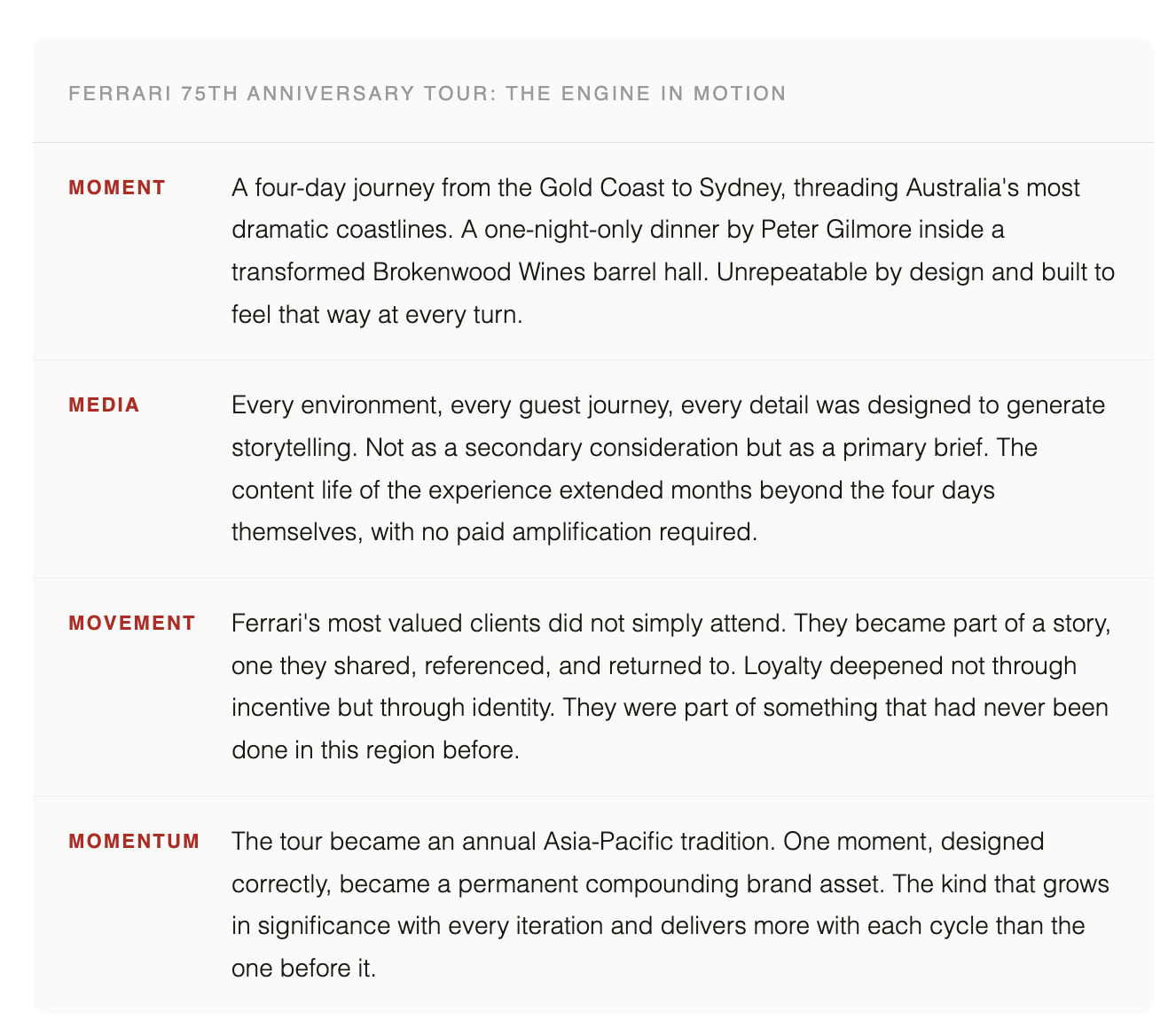
The commercial value of that activation was not realised on the day. It was realised across the years that followed through the story it generated, the community it created, and the momentum it built into the fabric of how Ferrari operates in this part of the world. That is what a compounding brand asset looks like in practice.
Why most brands only ever complete the first lap
The most important element of the Cultural Moment Engine is the one almost nobody is designing for: the loop. The arrow that connects Momentum back to Moment; the point at which a brand stops running campaigns and starts running a compounding system.
The compounding principle
Every moment feeds the next. Every cycle builds on the cultural equity of the last. The brands that understand this stop thinking about activations as expenses and start treating them as infrastructure. Assets that appreciate over time when the full system is working correctly.
A launch designed as a single event, measured over four weeks, with no architecture for what it is supposed to generate beyond immediate sales, is a moment without an engine. It burns brightly once. Then it is gone, and the cycle of spending resets to zero.
The brands defining their categories right now, in Australia and globally, are not running bigger campaigns. They are running more intelligent systems. They have understood that in a market where 88% of purchasing decisions are influenced by personal recommendation, the most important question is not "how do we reach more people?" It is "how do we build something people want to talk about and keep talking about?"
"In Australia, the most valuable marketing channel a brand can build is one that costs nothing to run. The genuine enthusiasm of a community that feels like it belongs to something real."
This applies to every brand. The scale is irrelevant. The thinking is everything.
The Cultural Moment Engine is not a framework reserved for global brands with global budgets. It applies to a product launch, a founder's personal brand, a market entry, a content strategy, or a single gathering of the right people in the right room. New Balance ran it with a run club. Unofficial Run Club runs it with zero paid media. Ferrari ran it across an entire continent.
The questions it demands are always the same. Is this moment genuinely worth attention or is it simply expected? What is it designed to produce and for whom? What community does it activate and how does it earn their belonging? What does this look like as a compounding system running for three years, not three weeks?
When those questions have honest answers, what gets built is categorically different. Not louder. Not more expensive. Built to last and built to compound.
The brands that will define the next decade in this market are not the ones with the biggest budgets. They are the ones with the clearest thinking and the discipline to design the entire engine, not just the first stage of it.
Take the conversation further
If you are building something that deserves more than a launch and you want to design the engine behind it, the conversation starts here. Start a conversation →